First: Causes of alkali return (white rust, black spots)
1.Formation mechanism of white rust
When galvanized parts are closely stacked and placed in damp air, due to the absence of freely flowing air on the surface between the plated parts, electrochemical corrosion will occur on the local surface of the coating and white rust will form. Due to the layer of condensed water adhering to the surface of the galvanized layer interacting with oxygen, carbon dioxide, hydrogen sulfide, sulfur dioxide, oxides and other chemical gases, a corrosive aqueous solution will be generated and adhere to the surface of the zinc layer, forming an electrolyte. And this electrolyte and the zinc layer produce electrochemical corrosion, thereby producing the white dotted and powdery substance (zinc oxide) visible to the naked eye. The secondary and tertiary oxidation products of white rust forming a local black appearance are all collectively referred to as the alkali return phenomenon.
2.Impact of white rust
Since the volume of metallic zinc increases by 3 to 5 times when it is converted into zinc oxide or zinc hydroxide, the formed white rust has a large volume, so the degree of white rust corrosion appears to be much more serious than the actual situation, which seriously affects the appearance of the coating. But in fact, they only cause a very small loss of zinc in the base coating. For thicker structural part coatings, usually white rust has no or no obvious impact on the durability and service life of the coating.
3.Treatment of white rust
A large amount of white rust may appear on the surface of galvanized parts, but the actual corrosion of the coating is relatively mild. In most cases, the appearance of white rust does not indicate that the coating has been seriously damaged nor does it necessarily mean that the service life of the plated part will be reduced. After white rust occurs, the plated parts should be spread out to make their surfaces dry quickly. On galvanized workpieces stored for a long time and with white rust, the typical white and gray corrosion products may turn black. When this situation occurs, as long as the zinc layer is thick enough, it will not affect the service life. In GB/T13912-2020, it is clearly stipulated that as long as the thickness of the coating is greater than the specified value, uneven color areas that are dark or light gray are allowed on the surface of the plated workpiece. For galvanized workpieces stored in damp conditions, white rust (white or gray corrosion products mainly composed of basic zinc oxide) is allowed on the surface.
In conclusion, due to factors such as weather, transportation, and storage, the phenomenon of white rust is a common phenomenon in galvanized products in summer. As long as the corroded zinc layer is higher than the standard value, it will not have any impact on the service life of the product.
Second: Precautions
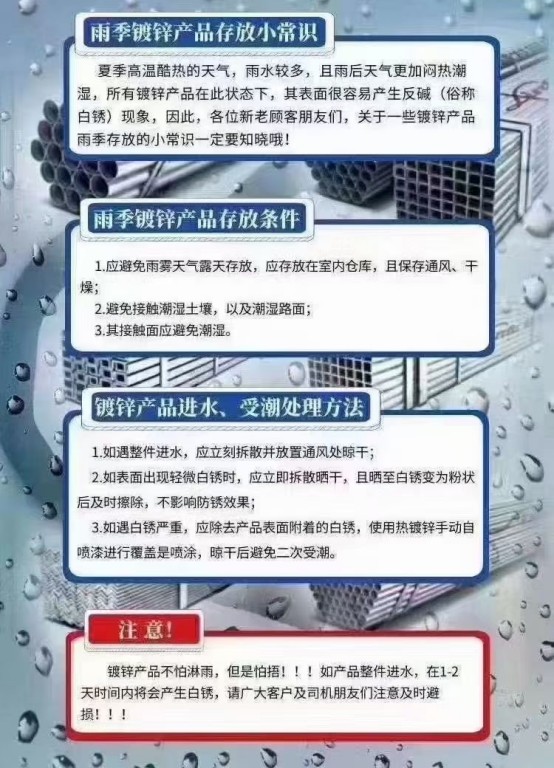
1.All galvanized products will produce white rust in damp, high temperature, airless, and corrosive environments. Products that are extremely prone to white rust: Angle steel, flat iron, steel plates, small-caliber square tubes, etc. After the products with tight packaging are sealed, if there is water accumulation inside, in hot and muggy weather, the water accumulation will cause moisture to return easily, resulting in the alkali return phenomenon of galvanized products.
2.For products that have been galvanized and processed, please ask customers to ship them in time. After arriving at the destination, unpack and store them in time. Keep the warehouse ventilated. Remember not to cover the package.
3.If there are slight white rust or spots on the surface, immediately disassemble and dry it. After ventilation until the white rust turns into powder, promptly wipe it off with a brush and use hot-dip galvanized manual spray paint for covering spraying, which does not affect the anti-corrosion effect.
4.In humid and muggy weather, try to store indoors to keep it ventilated and dry. When stacking, avoid direct contact with damp soil.
5.Galvanized products are not afraid of high temperature, humidity, or concentrated stacking, but they are afraid of the combination of these three at the same time, that is, in a humid (including rain and fog and air humidity > 50%) and muggy (temperature > 26°C) environment with concentrated stacking.



 Location:
 Time:2024-08-06
  Hits:505
  2025-05-30

